
SaaS security tooling market
0
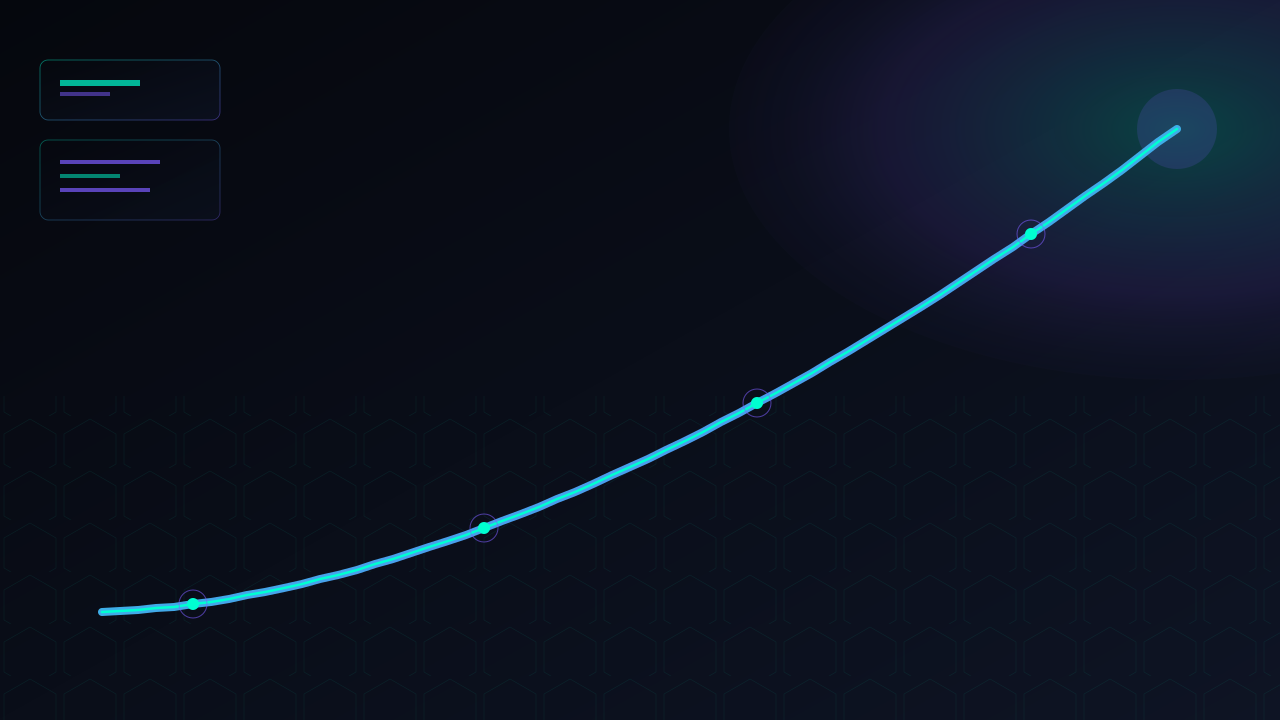
Industry research band — growing toward $20B+ by 2030.
Mandala IT hardens B2B SaaS platforms against the failure modes that scale with multi-tenancy: cross-tenant data leakage, customer-facing API abuse, tenant impersonation, and the audit-evidence drift that SOC 2 examiners surface every cycle.
B2B SaaS security tooling has shifted from optional to procurement-table-stakes.
Industry research band — growing toward $20B+ by 2030.
Industry average per IBM Cost of a Data Breach across SaaS/tech.
Public multi-tenant data-leak disclosures rising as SaaS market matures.
Every enterprise customer asks how do you prevent tenant-X data from reaching tenant-Y. The vendor with continuous evidence wins.
SaaS buyers consume defense as per-tenant + per-API-call usage — exactly the shape of performance-based billing.
Eight overlapping risks — every one undermines tenant trust or surfaces during a SOC 2 / ISO audit.
One customer's query reaches another customer's data — the trust-killing failure mode.
Tenant exhausts shared budget; or attacker harvests via legitimate API keys.
B2B login compromise → tenant takeover → admin-role exfiltration.
JWT / session-token forgery to cross the tenancy boundary.
Access-log gaps and missing change-management records surface during audit.
Your vendor's breach becomes your customer's incident (Okta, MOVEit pattern).
Introspection probes and error-leakage map your data model for attackers.
Browser extensions, JS dependencies, and third-party scripts in your customer UI.
Mandala IT operates inside the rapidly expanding SaaS security tooling segment, delivering a unified detection-and-evidence layer designed to enforce tenant boundaries, defend customer APIs, and produce SOC 2 / ISO evidence by default.
“Multi-tenant SaaS security is one boundary problem repeated thousands of times. The right engine produces the evidence that this boundary held — continuously, not at audit-week.”
Mandala IT introduces a model where SaaS vendors primarily pay against tenant-isolation breaks prevented, customer-API abuse stopped, and SOC 2 evidence delivered.
Per-tenant pricing means startups can adopt early and scale billing with growth.
Provider revenue rises when tenant trust and audit posture improve.
Per-tenant compliance exports are a billable line — your customers' auditors get what they need.
Continuous API volume = continuous scoring = continuous billing.
Same engine serves Series-A founder, Series-C VP Engineering, and post-IPO CISO.
Tenant boundary is enforced at query, cache, queue, and storage — independently. Every crossing attempt produces an audit row your customers' auditors can read.
Five pillars under one engine — the bundle every B2B SaaS CISO / CTO buys together.
A near-miss cross-tenant query during dual-region migration surfaced during the pre-IPO security workstream. The Drata deployment was reporting clean, but the underwriter's diligence team was asking for evidence the boundary actually held continuously, not just at audit week.
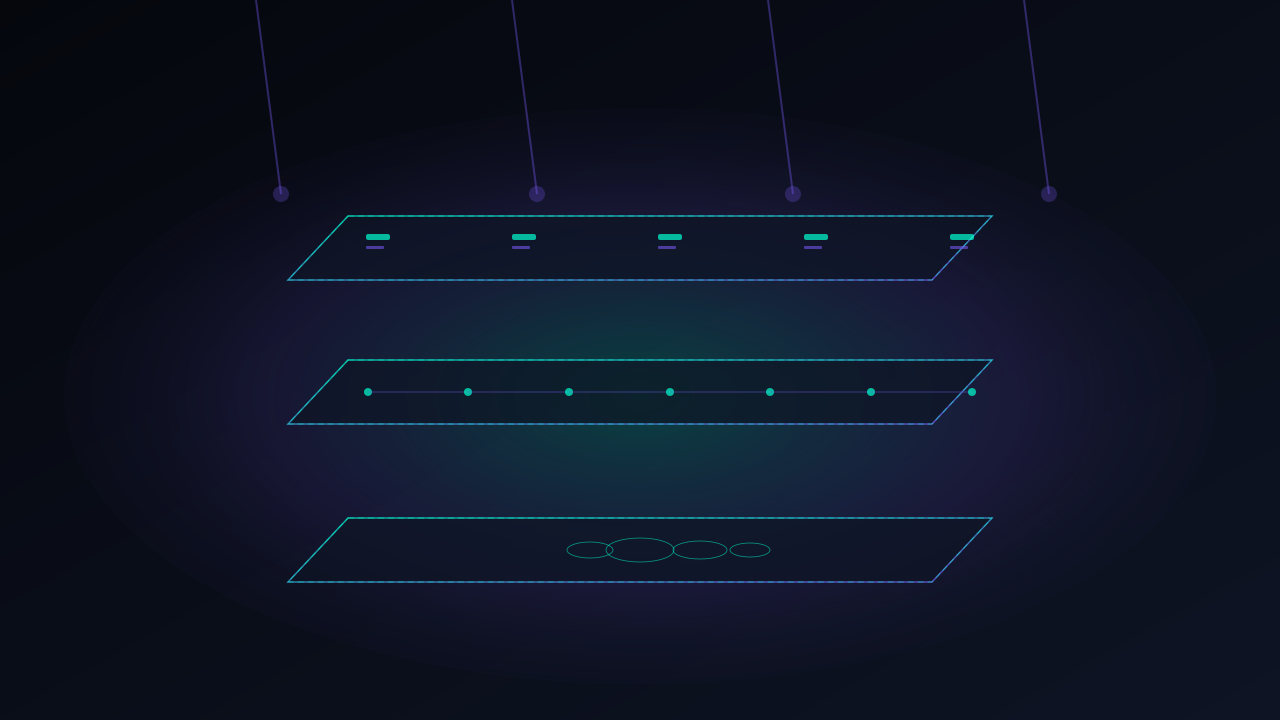
Every relevant event is evaluated by six cooperating layers in under 200ms.
Decide who is on the other end — and which tenant they belong to.
Decide whether the API call pattern is real, in real time.
Stop the abuse at the door of the customer-facing API.
Decide whether the source is already known to be hostile.
Your platform team's cockpit. Where our hours and your per-event fees are reconciled each month.
Produce the evidence package your customer's auditor will accept.
More data per tenant = more severity per cross-tenant failure.
Enterprise buyers will not sign without SOC 2 / ISO evidence — and the bar keeps rising.
Every B2B SaaS is now an API platform — the attack surface grows accordingly.
High-value tenant data attracts targeted attacks.
Okta-2022 / MOVEit-2023 patterns drive subprocessor disclosure expectations.
Note. Scope, deliverables, timelines, and SLA tiers are agreed in a mutual Statement of Work. Commitments on this page are illustrative; binding terms live in the engagement contract.
In-line sidecar at the gateway or a verdict webhook for async paths. Compatible with Kong, Tyk, AWS API Gateway, custom Envoy / Nginx.
Reference clients in this vertical are arranged after the first scoping call under mutual NDA. Most of our SaaS clients are pre- or post-IPO and contractually cannot be named publicly — that goes both ways. Comparable-size reference calls are scheduled before SOW signature.
Tiered per-tenant pricing plus per-API-call usage. Negotiated caps for unusually large customer estates.
Series-B through pre-IPO B2B SaaS where multi-tenancy is material and dedicated platform-security is not yet scaled.
We commit to measurable improvement against your baseline — quantified per engagement in the Statement of Work. SLA-backed commitments and clear remedies, not vague guarantees.
Scoping call within 2 business days. Signed Statement of Work typically within 7–14 days. Monitoring live within 30 days of SOW for standard engagements; emergency incident-response retainer can be activated within 24 hours.
We deliver primarily with directly-employed analysts and engineers. Where a vertical needs specialist coverage (forensics, firmware analysis, jurisdiction-specific filings), named partners are disclosed in the SOW before signature — never silently white-labelled.
We integrate with your existing GRC tool rather than displace it. Our team tunes per-tenant evidence collection, runs the customer-auditor delivery workflow, and owns the subprocessor-disclosure ledger. The GRC tool reports the state; we maintain it.
Region-specific options — EU, UK, US, Israel, GCC — are scoped per engagement. BAA (US healthcare), DPA (EU), and ISO 27001-aligned controls are issued under the engagement contract. Production data and PII do not leave your designated region without written consent.
After the first scoping call, under mutual NDA. Most of our clients are regulated and contractually cannot be named publicly. Reference calls with comparable-size buyers in your vertical are arranged before SOW signature.